All About Buchholz Relays: Protecting Transformers from Internal Faults
The transformer is a crucial piece of equipment in our electrical grid, but like any machinery, it can malfunction.
Buchholz relays play a vital role in protecting transformers from internal faults that could lead to overheating or short circuits.
This blog post dives into the world of Buchholz relays, explaining their function, operation, and importance in safeguarding transformers.
What is a Buchholz Relay?
A Buchholz relay is a safety device specifically designed for oil-immersed transformers. It acts as a guardian, monitoring the transformer's internal health and triggering an automatic shutdown in case of trouble.
How Does it Work?
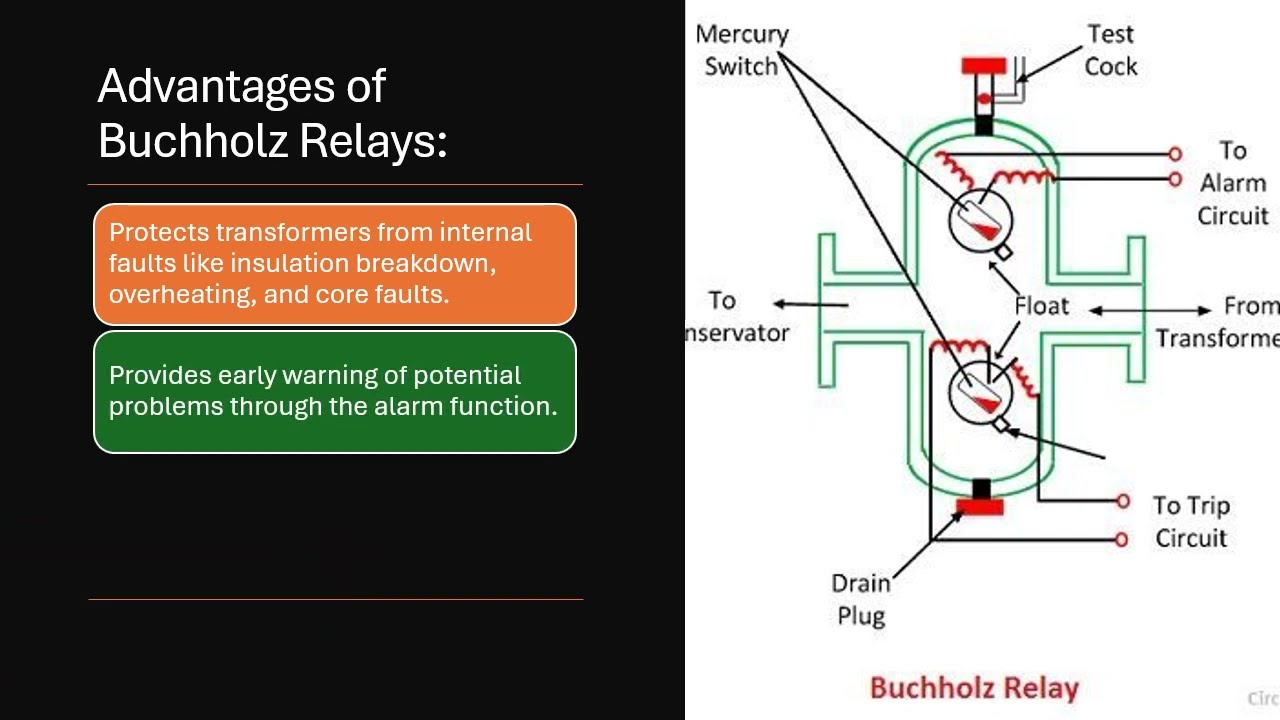
The Buchholz relay is installed in the pipeline connecting the transformer's main tank and the conservator tank (a separate chamber that holds excess oil). It operates based on two key principles: gas detection and oil flow.
Gas Detection: When a fault occurs inside the transformer, the insulating oil decomposes, generating gas bubbles. These bubbles rise and accumulate in the Buchholz relay.
Oil Flow: Depending on the severity of the fault, a surge of hot oil might also rush through the relay.
How Does The Buchholz relay Trigger a Shutdown?
The Buchholz relay houses two hinged floats with built-in mercury switches.
Minor Faults: Gas accumulation due to minor faults tilts the upper float, activating the mercury switch and triggering an alarm. This allows for early intervention before the issue escalates.
Serious Faults: In severe fault scenarios, the rapid gas generation creates a strong surge of oil flow within the relay. This force flips the lower float, triggering the mercury switch connected to the circuit breaker. This critical action isolates the faulty transformer from the power supply, preventing further damage.
Why is Mercury Used?
Mercury's unique property as a liquid metal plays a key role. In the relay's normal position, the mercury switch is tilted due to the float's hinge, keeping the circuit open. When the float tilts due to gas or oil flow, the mercury levels out, completing the circuit and triggering the desired action.
Advantages of Buchholz Relays:
Protects transformers from internal faults like insulation breakdown, overheating, and core faults.
Provides early warning of potential problems through the alarm function.
Offers a reliable and relatively simple protective mechanism.
Disadvantages of Buchholz Relays:
Limited to oil-immersed transformers.
Ineffective if the oil level falls below a certain point.
Conclusion:
Buchholz relays are silent guardians, safeguarding transformers from internal threats. By understanding their working principles and limitations, we can appreciate their role in ensuring the smooth operation of our power grid.
- Category
- Twitch Hot Tub
Commenting disabled.
Up Next
Autoplay
-
02:20

Transformers: EarthSpark | NEW SERIES | What's up with Twitch & Thrash? | Transformers Official
-
24:13

News Roundup for August 8th - SS86 Ironhide, Canon x Transformers, Transformers RPG
-
00:42

MEGAN FOX HOT SCENE IN TRANSFORMERS #HOT #meganfox #transformers #movieclips
-
00:17

THE NEW TRANSFORMERS MOVIE 2026 YOU GOTTA SEE THIS #transformers #robot #robotics #shorts #short #yt
-
00:30

Twitch's Solution To Hot Tub Streams #shorts
-
38:16

What should Twitch do about hot tub streams? || The Stanz Show #14
-
06:36

amouranth demonetized by twitch hot tub meta destroyed - lol
-
12:16

Twitch Adds a New Category for Hot Tub Streams