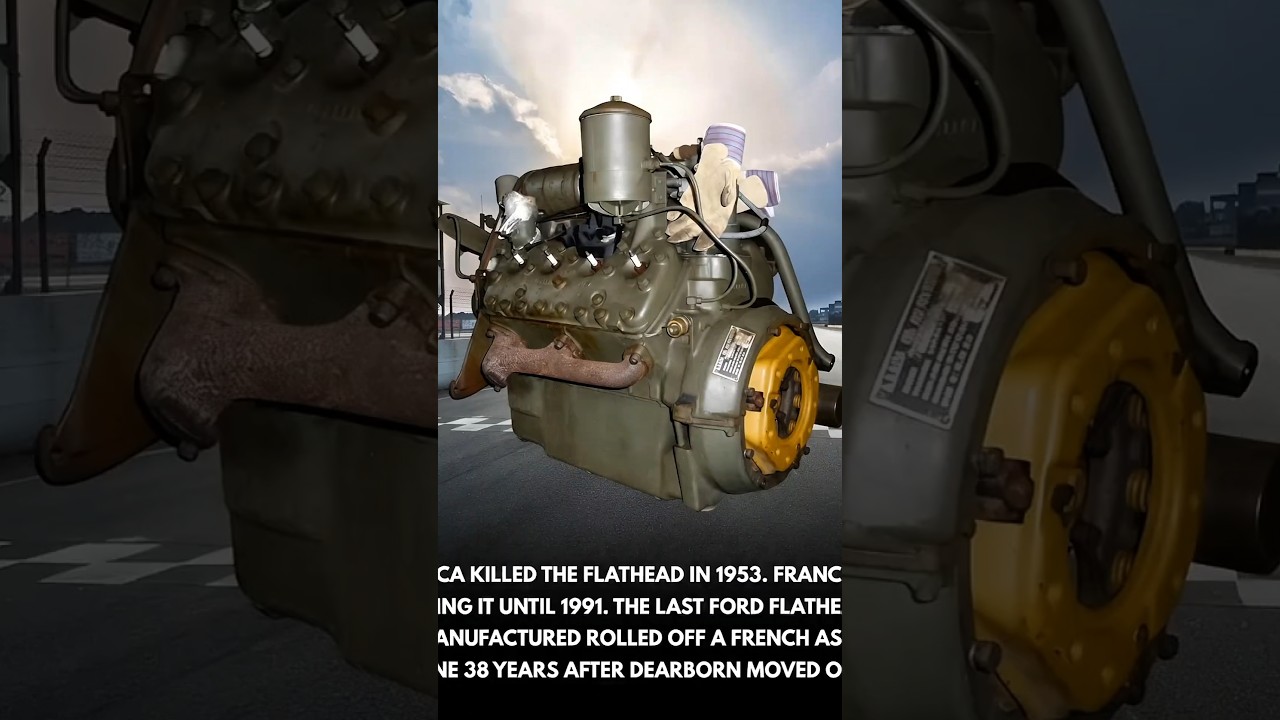
On a metal ID plate riveted to a new-old-stock Ford Flathead V8 engine, the production date reads 28 March 1991. Nineteen ninety-one. The year the Soviet Union collapsed. The year Nirvana released Nevermind. Thirty-eight years after Ford built the last Flathead in Dearborn. Thirty-seven years after the Y-Block overhead-valve V8 replaced it. And a factory in France was still casting, machining, and assembling brand-new Flathead V8s with the same bore, the same stroke, and the same L-head valve architecture that Henry Ford had introduced in 1932. The longest-running production engine in Ford history wasn't built by Ford. It was built by the French military's industrial supply chain, under license, in a country that refused to let the Flathead die because it was too useful to replace.
The story begins in 1954 when Simca purchased Ford SAF (Société Anonyme Française) and the Poissy factory that had been building Ford vehicles in France since the 1930s. Ford's tooling for the 239-cubic-inch (3,923 cc) Flathead V8 transferred to Simca. In 1962, the SUMB (Simca Unic Marmon Bocquet) MH600BS entered production as the French Army's standard 1.5-ton 4x4 tactical truck, powered by the Flathead V8 designated F7 CWM. One hundred horsepower. 24-volt electrical system. Four-speed synchronized gearbox with a two-speed transfer case for front axle engagement. Portal axles by Marmon-Herrington that raised the chassis above the axle centerline for additional ground clearance. The SUMB replaced America's WWII-surplus Dodge trucks that had served the French military since liberation. An American engine design, built in a French factory, in a truck designed by a French-American-Italian corporate partnership, replacing American trucks that had arrived with the D-Day invasion.
The French Flathead was not identical to the American version. The castings were improved: thicker cylinder walls, better metallurgy, less core shift, and tighter tolerances than the wartime and postwar American blocks. Factory-installed hardened valve seats accommodated the unleaded fuels that became standard in Europe decades before America adopted them. Metric fasteners replaced most of the American imperial hardware, though critical dimensions — bore spacing, deck height, main bearing journals — remained American standard to maintain compatibility with the original tooling. The bore and stroke were identical to the American 239: 3.1875 inches bore, 3.75 inches stroke. Output: 95 HP at the French military's conservative rating, with 170 lb-ft of torque. The French Flathead breathed through a single downdraft Solex carburetor instead of the American Holley or Ford units.
Hot rodders discovered the French Flathead in the 2000s when SUMB trucks began appearing at military surplus sales across Europe. The engines were pulled from trucks, cleaned, and shipped to American hot rod builders who recognized what they had: brand-new Flathead V8 blocks with better metallurgy than any original Ford casting, already fitted with hardened valve seats, and capable of being bored further than American blocks because the thicker cylinder walls provided more material to remove. A French military Flathead in a 1932 Ford roadster gave the builder an engine that looked and sounded perfectly period-correct but was stronger internally than anything Henry Ford's foundry had produced. The irony was complete: an American engine design, abandoned by America in 1953, improved by France for military use, manufactured until 1991, and shipped back to America forty years later to power the hot rods that the original Flathead had created. The engine that started hot rodding in the 1940s was still being manufactured when hot rodders rediscovered it in the 2000s. Just not in America.
- Category
- Twitch Hot Tub
- Tags
- USA car, engine, amrican car
Commenting disabled.
Up Next
Autoplay
-
00:10

Engine had some metal in oil filter. 20psi hot idle. Decided to yank engine and put the spare in.
-
41:06
43-Ton Steel Plate Bent Like Paper. Plate Rolling & Heavy Metal Fabrication
-
31:51

Will it run and drive after 60 plus years 1941 ford COE flathead v8 truck
-
00:14

Functional Stirling Engine Airplane Model, Metal Hot‑Air Engine Desktop Ornament
-
00:30

Twitch's Solution To Hot Tub Streams #shorts
-
38:16

What should Twitch do about hot tub streams? || The Stanz Show #14
-
06:36

amouranth demonetized by twitch hot tub meta destroyed - lol
-
12:16

Twitch Adds a New Category for Hot Tub Streams