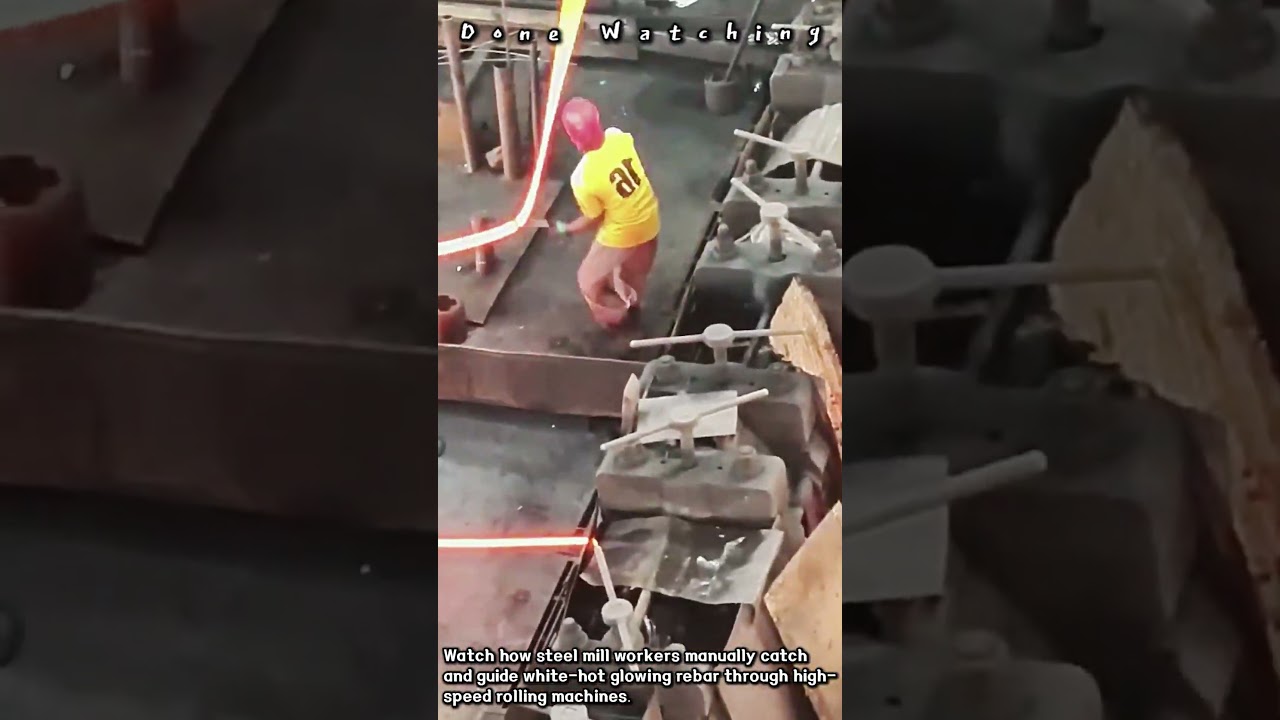
## 1. Content & Video Overview
This video showcases an intense manual rebar rolling process taking place inside a traditional steel rolling mill. Workers use specialized heavy tongs to manually catch, bend, and loop glowing white-hot steel strands moving at high speeds between consecutive rolling stands. The footage highlights exceptional timing, synchronized teamwork, and physical coordination under extreme thermal conditions.
## 2. Materials, Tools & Environmental Analysis
- Primary Material: High-temperature structural steel billets forged into elongated rebars glowing above 1,000°C (1,832°F).
- Equipment & Tools: Industrial motor-driven rolling mill stands, guiding channels, heavy-duty metal catching tongs, and protective thermal footwear.
- Environmental Conditions: High heat radiation industrial environment requiring continuous situational awareness, quick physical reflexes, and rhythmic floor coordination.
## 3. Specific Features & Process Walkthrough
- Step 1 (Entry & Catching): As the hot steel rod exits the primary reduction roller, a skilled technician catches the leading end using long industrial tongs.
- Step 2 (Looping & Guiding): The worker swiftly maneuvers the glowing rod in a wide arc to maintain tension and feed it into the next mechanical rolling station.
- Step 3 (Successive Deformation): Multiple operator stations work in sequence to progressively reduce the cross-sectional area of the hot bar to the target rebar diameter.
- Step 4 (Thermal Discharge): The finished hot steel strand continues down the cooling line for structural tempering and cut-to-length processes.
## 4. Significance of the Operation & Key Watching Points
- Mechanical Engineering Insight: Demonstrates hot rolling metallurgy principles where metal recrystallization occurs simultaneously during continuous plastic deformation.
- Skill & Coordination: Highlights human dexterity in manual metalworking systems where split-second reflexes prevent material buckling or machinery jams.
- Visual Focus: Pay attention to the fluid movement of the glowing red-hot steel loop as it sweeps across the floor without touching the operators.
## 5. Guideline Compliance & Educational Purpose
This content is published strictly for educational, informational, and historical industrial documentation purposes. It serves to illustrate structural steel manufacturing techniques, industrial physics, and manual metallurgical processes. All activities shown were performed by trained industrial professionals within a controlled manufacturing facility. Viewers are strongly advised not to attempt or replicate any dangerous practices involving high-temperature metals or industrial machinery.
- Category
- Twitch Hot Tub
- Tags
- 쇼츠, 신기한영상, 챌린지
Commenting disabled.
Up Next
Autoplay
-
1:44:07

ONE on ONE Full Episodes 2023????????S05 E01 One On One Remix ????????ONE on ONE full Season
-
00:07
How Workers Control Glowing Hot Steel in Seconds #SteelMill #Manufacturing #Factory
-
00:07
Watch What Happens When Red Hot Steel Moves #SteelMill #HotMetal #Factory
-
00:08
Dodging Glowing Steel At Full Speed #worker #process #steelmill #hotmetal #factory
-
00:30

Twitch's Solution To Hot Tub Streams #shorts
-
38:16

What should Twitch do about hot tub streams? || The Stanz Show #14
-
06:36

amouranth demonetized by twitch hot tub meta destroyed - lol
-
12:16

Twitch Adds a New Category for Hot Tub Streams