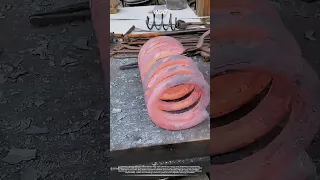
Heat First, Then Pull: The Old Way to Tame a Spring
Cold steel listens to no one. A spring coiled into tight loops keeps its shape by design, and no amount of pulling will make it lie straight while it stays cold—the metal simply resists and snaps back. For centuries, blacksmiths and field workers solved this with a rule as old as fire itself: make it red, make it soft, then make it obey. Heat does the hard part; the hands only finish the job.
Here a worker heats one section of a spring to a glowing orange with a torch, then leans back hard, using his body weight to draw the softened wire straight against a wooden post and a fixed crossbar. The rod serves as the anchor, the torch as the key. In that moment, metal that once fought him gives way and holds the new shape once it cools.
Red heat means give: At high temperature the metal's crystal structure relaxes, and coils that resist when cold turn pliable.
The post does the pulling with you: A fixed anchor turns body weight into long, even tension.
Lean back, not wrench: Steady, continuous pull beats sudden force and keeps the metal from cracking.
The torch sets the pace: Heat the spot that matters, pull there, then let it cool into place.
Old tools, honest craft: A post, a bar, and a flame still straighten what machines often replace.
In the end, straightening metal is less about strength than about timing—heat it until it yields, and the pull becomes nothing more than a patient goodbye to an old shape.
- Category
- Twitch Hot Tub
Commenting disabled.
Up Next
Autoplay
-
13:30

Chiếc xe đồ chơi có thể gây ra Thế Chiến thứ 3 - review phim Ở Nhà Một Mình 3
-
00:22

Xàm dị gaming - sinh tồn trong thế giới tận thế sikibidi #gameshort #funnygame
-
Hot steel coil spring shaping technique to adjust heated spring coils and form uniform spiral
-
00:21
Hot Worked Coil Spring Process #machine #spring #process #processing #mechanical #technology
-
00:30

Twitch's Solution To Hot Tub Streams #shorts
-
38:16

What should Twitch do about hot tub streams? || The Stanz Show #14
-
06:36

amouranth demonetized by twitch hot tub meta destroyed - lol
-
12:16

Twitch Adds a New Category for Hot Tub Streams